

An independent guide to mortgage financing in Finland and abroad, including eligibility, deposits, interest rates, property collateral, fees and cross-border financing risks.
Buying a property is one of the largest financial decisions most people make. For international buyers, expatriates and people relocating between countries, choosing the right mortgage can be more complicated than comparing interest rates.
Should you apply for a Finnish mortgage through a bank in Finland, or would an international mortgage provide greater flexibility?
The answer depends on where the property is located, your country of residence, income currency, deposit, credit history and long-term financial plans.
Finnish mortgages generally operate within Finland’s banking and property financing framework. International mortgages, by contrast, involve cross-border borrowing or financing arrangements for property purchases outside the borrower’s home country.
Both approaches can be appropriate, but they have different eligibility requirements, financial risks and borrowing costs.
This guide explains the key differences between Finnish and international mortgages, including the considerations that matter most to foreign property buyers.
For additional information about housing finance, savings and financial products in Finland, explore WiTRaha – Finnish Financial Comparisons.
If you are purchasing property abroad, relocating internationally or managing finances across multiple countries, WiT Access – International Finance and Global Mobility provides further resources.
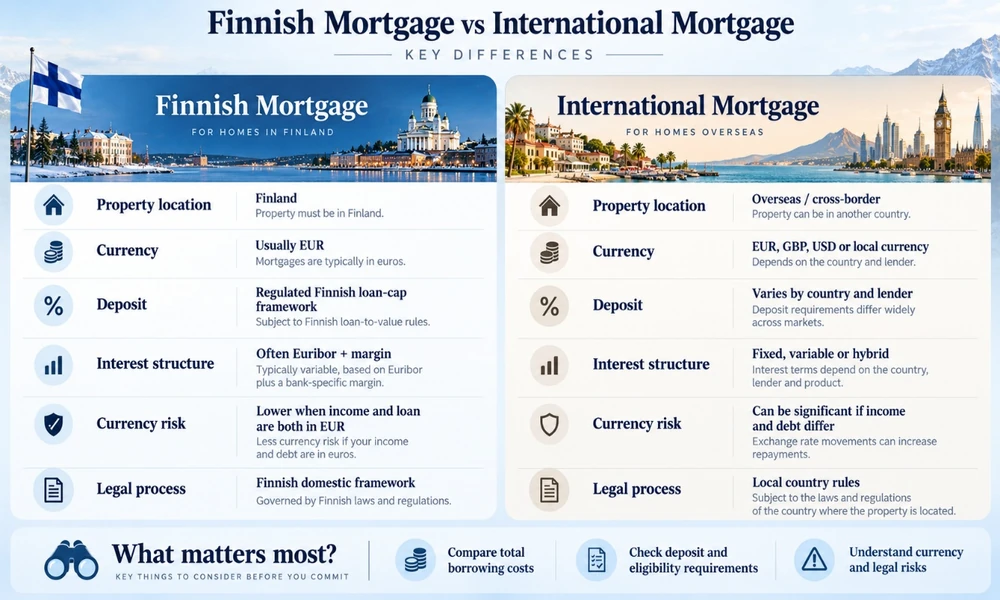
Finnish Mortgage vs International Mortgage: Quick Comparison
The most important difference is usually the location of the property securing the loan.
A Finnish bank financing a property in Finland can assess collateral under familiar domestic laws and valuation practices. Cross-border financing can introduce additional legal, currency and enforcement complexity.
| Feature | Finnish Mortgage | International Mortgage |
| Typical property location | Finland | Another country or cross-border transaction |
| Common lending currency | Euro (EUR) | EUR, GBP, USD or local currency |
| Interest-rate structure | Often Euribor-linked variable rates; fixed options may be available | Variable, fixed or hybrid, depending on market |
| Deposit requirements | Subject to Finnish loan-cap rules and lender underwriting | Vary by jurisdiction, lender and borrower residency |
| Credit assessment | Income, debts, expenses, repayment capacity and collateral | Similar factors plus potentially greater cross-border scrutiny |
| Foreign income | May be accepted following additional assessment | Often considered by specialist international lenders |
| Collateral | Usually Finnish property or housing-company shares, with other security where needed | Usually property in the lender’s supported jurisdiction |
| Documentation | Finnish identification, income and property information | May require foreign tax, legal, income and residency records |
| Currency exposure | Lower if income and loan are both in euros | Potentially significant where income and debt differ |
| Legal process | Finnish mortgage and property rules | Rules of the relevant property and lending jurisdiction |
| Best suited to | Eligible buyers purchasing property in Finland | Buyers financing property abroad or managing cross-border circumstances |
Important: An international mortgage is not a single standardised product. Its legal and financial characteristics depend on the lender, property location and applicable jurisdiction.
1. What Is a Finnish Mortgage?
A Finnish mortgage, commonly known as an asuntolaina, is a housing loan generally used to purchase residential property in Finland.
It is typically provided by a bank or other authorised lender and secured against eligible property collateral.
Depending on the transaction, borrowers may use it to finance:
- Apartments in Finnish housing companies.
- Detached houses.
- Terraced houses.
- Certain holiday properties.
- Other eligible residential properties.
Finnish residential property ownership has an important structural distinction.
Many apartment purchases involve acquiring shares in a housing company that entitle the shareholder to possess a particular apartment.
By contrast, buying a detached house may involve acquiring a registered real estate unit.
This distinction matters because the collateral documentation, property-related obligations and transfer tax treatment can differ.
How Finnish mortgage interest works
Many Finnish mortgages use a variable interest rate linked to Euribor.
The total interest rate generally consists of:
Mortgage Interest Rate = Reference Rate + Bank Margin
For example:
- Illustrative Euribor reference rate: 2.50%.
- Bank margin: 0.70%.
- Total mortgage interest rate: 3.20%.
The reference rate may reset periodically according to the agreement.
The bank margin depends on the lender’s assessment and negotiated loan conditions.
Fixed-rate and interest-protection alternatives may also be available.
The figures above are hypothetical and should not be interpreted as current market offers.
Who typically uses Finnish mortgages?
Finnish mortgages are relevant to:
- Finnish citizens buying homes in Finland.
- Foreign nationals legally residing in Finland.
- International professionals employed in Finland.
- Eligible expatriates purchasing Finnish property.
- Returning Finnish residents.
- Certain non-resident applicants with sufficient ties to Finland.
However, eligibility is assessed individually.
Owning Finnish property or holding Finnish citizenship does not automatically guarantee loan approval.
2. What Is an International Mortgage?
An international mortgage generally refers to property financing with a cross-border element.
This could involve:
- A Finnish resident buying property in Spain.
- A British citizen financing a home in Finland.
- A European expatriate purchasing property in the United Kingdom.
- An international professional buying a second home outside their country of residence.
- A non-resident investor financing overseas residential property.
In practice, the financing may be provided by a bank in the country where the property is located, or by a lender specialising in internationally mobile borrowers.
For example, a Finnish resident buying a property in Spain may seek financing from a Spanish bank.
That does not necessarily mean a Finnish bank will accept the Spanish property as collateral.
Mortgage lenders often prefer security located in jurisdictions where they have established valuation, registration and enforcement procedures.
Common international mortgage structures
International property financing can include:
Local-country mortgage
A mortgage provided by a lender in the country where the property is located.
Expatriate mortgage
A mortgage designed for eligible borrowers living or earning income outside the property jurisdiction.
Non-resident mortgage
Financing offered to qualified property buyers who are not residents of the country where the property is located.
Cross-border private banking finance
A financing arrangement sometimes available to qualifying private banking clients, potentially supported by property or other eligible assets.
Home-equity-backed borrowing
Financing secured against an existing property or other assets, with proceeds used for an overseas purchase.
These structures involve different risks. In particular, borrowing against an existing home exposes that property to potential enforcement if the loan is not repaid.
3. Mortgage Eligibility: Finland vs International Lending
Mortgage eligibility is one of the biggest differences between domestic and cross-border financing.
Finnish mortgage eligibility
Finnish lenders assess factors such as:
- Stable and verifiable income.
- Employment or business income.
- Existing debts.
- Household expenditure.
- Creditworthiness.
- Available savings.
- Loan repayment capacity.
- Property value and collateral quality.
- Residency and identification.
- Relevant financial connections to Finland.
Foreign applicants may face additional verification, particularly when their income, assets or tax records originate abroad.
A borrower with a Finnish salary, established residence and accessible income records may find the process more straightforward than a non-resident whose income and assets are held overseas.
International mortgage eligibility
International lenders may also evaluate:
- Country of residence.
- Nationality, where legally relevant.
- Currency of income.
- Foreign tax returns.
- Overseas employment contracts.
- International credit history.
- Local property valuation.
- Local legal requirements.
- Source of deposit funds.
- Debt commitments in multiple countries.
Some lenders specialise in foreign buyers, while others restrict lending to people with domestic income or residence.
Can foreigners obtain mortgages in Finland?
Yes, eligible foreign nationals may apply for Finnish mortgages.
There is no universal rule that every foreign borrower must hold Finnish citizenship.
However, banks can assess residency, repayment capacity and financial circumstances.
EU rules prohibit certain forms of nationality-based discrimination, but they do not require lenders to approve every cross-border application.
A lender can still decline financing because of legitimate credit, collateral, legal or operational considerations.
4. Mortgage Deposits and Loan-to-Value Ratios
The required deposit is another important consideration.
Finnish mortgage loan caps
Finland applies statutory maximum loan-to-value rules for housing loans, subject to the applicable supervisory framework and collateral calculations.
The standard reference caps are:
- 90% for ordinary housing loans.
- 95% for qualifying first-home loans.
In simplified terms, a 90% financing structure may imply that at least 10% of the relevant collateral value must be covered by savings or additional acceptable collateral.
However, the statutory cap is based on the relevant collateral valuation and does not guarantee that a bank will lend 90% of the property’s purchase price.
Lenders can impose stricter requirements.
Supervisory rules may also change, so applicants should verify the applicable cap at the time of application.
Finnish mortgage example
Suppose a home has a purchase price of €250,000.
Under an illustrative 90% loan scenario:
| Item | Amount |
| Purchase price | €250,000 |
| Mortgage amount | €225,000 |
| Buyer contribution | €25,000 |
| Loan-to-price ratio | 90% |
This assumes that the property’s accepted collateral value and any other required conditions support the calculation.
It excludes purchase taxes, registration charges, arrangement fees and additional reserves.
International mortgage deposits
International deposit requirements vary substantially.
A non-resident borrower may face a stricter financing limit than a local resident.
For example, a hypothetical international lender offering 70% financing on a €250,000 property would produce:
| Item | Amount |
| Purchase price | €250,000 |
| Mortgage amount | €175,000 |
| Buyer contribution | €75,000 |
| Loan-to-price ratio | 70% |
The difference in upfront contributions is €50,000.
This does not establish that international mortgages universally require 30% deposits. It illustrates how lender policy can materially change upfront capital requirements.
5. Interest Rates: Euribor vs International Mortgage Pricing
Interest rate structures can affect affordability over the entire mortgage term.
Finnish mortgage rates
Finnish mortgage pricing often uses a Euribor reference period plus a bank-specific margin.
For example:
6-month or 12-month Euribor + lender margin
The reference rate changes according to the agreed reset schedule.
Borrowers therefore need to consider the effect of future interest-rate increases.
International mortgage rates
International mortgage rates depend on the relevant lending market.
- Fixed rates.
- Variable rates.
- Central bank-linked rates.
- Interbank or other benchmark rates.
- Hybrid fixed-variable structures.
- Initial promotional rates.
A fixed mortgage rate may offer payment predictability for its agreed period, but could carry early repayment charges or different refinancing conditions.
A variable rate can move in response to the applicable benchmark.
Example: Monthly mortgage payments
Consider a €200,000 repayment mortgage over 25 years.
| Illustrative Interest Rate | Monthly Principal & Interest |
| 3.0% | €948 |
| 4.0% | €1,056 |
| 5.0% | €1,169 |
| 6.0% | €1,289 |
These payments assume a constant annual nominal rate converted to monthly instalments, with no fees and no changes in rates throughout the period.
At 3%, the monthly payment is approximately €341 lower than at 6%.
The example demonstrates why comparing both interest rates and rate structures is important.
For additional research on Finnish home loans and financial products, explore WiTRaha’s mortgage and personal finance comparison resources.
6. Currency Risk: A Major International Mortgage Difference
Currency risk is one of the most important factors in cross-border borrowing.
A borrower whose income and mortgage are in the same currency generally has less direct exchange-rate exposure than someone whose earnings and debt are denominated in different currencies.
Example: Income in euros, mortgage in pounds
Suppose an internationally mobile borrower earns income in euros but makes mortgage payments of £1,000 per month.
At an illustrative exchange rate of:
£1 = €1.15
The monthly payment is equivalent to €1,150.
If sterling strengthens to:
£1 = €1.25
The same £1,000 payment would cost €1,250.
The borrower now pays €100 more per month in euro terms, even if the sterling mortgage payment has not changed.
Over a year, that difference represents €1,200.
This is a simplified currency illustration, excluding conversion fees and spreads.
How to evaluate currency risk
Consider:
- Income currency.
- Mortgage currency.
- Property value currency.
- Savings currency.
- Future relocation plans.
- Currency conversion fees.
- Emergency cash reserves.
Where practical, matching borrowing currency with reliable income currency can reduce direct payment exposure.
However, property value, refinancing needs and future relocation can still create financial risks.
For further cross-border financial planning guidance, visit WiT Access – International Banking and Financial Mobility.
7. Mortgage Fees and Property Purchase Costs
Mortgage costs extend beyond the interest rate.
Borrowers should compare the full cost of financing and ownership.
Finnish mortgage-related costs
Potential costs include:
- Mortgage arrangement fees.
- Account or loan servicing charges.
- Property valuation fees.
- Collateral registration costs.
- Property acquisition taxes.
- Insurance.
- Early repayment costs where applicable.
- Other agreed banking charges.
Finnish property transfer tax
As of October 2026, the standard Finnish transfer tax rates are:
| Property Type | Transfer Tax |
| Shares in a housing company | 1.5% |
| Direct real estate ownership | 3.0% |
For housing-company shares, the tax base generally includes the debt-free purchase price, including the relevant unpaid housing-company loan allocation.
For example, a housing-company apartment with a €250,000 debt-free purchase price generally produces:
€250,000 × 1.5% = €3,750 transfer tax.
A direct real estate purchase of €250,000 would generally produce:
€250,000 × 3.0% = €7,500 transfer tax.
Different legal structures and special circumstances may affect the final treatment.
Finland’s former first-time homebuyer transfer tax exemption was abolished for purchases made from 1 January 2024.
International mortgage costs
Overseas financing may involve additional expenses such as:
- Local property purchase taxes.
- Notary fees.
- Legal representation.
- Land registration.
- Currency conversion.
- Translation.
- International document verification.
- Local valuation.
- Mortgage brokerage.
- International funds transfer.
- Mortgage insurance where applicable.
These costs vary significantly by jurisdiction.
When comparing mortgages, calculate total purchase and financing costs rather than considering the headline interest rate alone.
8. Finnish Housing-Company Loans: An Important Local Difference
One feature that international property buyers may find unfamiliar is the Finnish housing-company loan system.
Many apartments in Finland are owned through shares in a housing company.
In certain cases, the housing company itself has outstanding debt allocated among apartments.
Buyers may encounter two different prices:
Selling Price – Myyntihinta
The amount payable directly to acquire the apartment shares, excluding the allocated outstanding housing-company loan.
Debt-Free Price – Velaton Hinta
The selling price plus the apartment’s allocated share of housing-company debt.
Example
Suppose an apartment has:
- Selling price: €180,000.
- Allocated housing-company loan: €40,000.
- Debt-free price: €220,000.
A buyer focusing only on the €180,000 selling price could underestimate their total housing-related financial obligations.
The housing-company debt may be reflected in monthly financing charges or be repayable under applicable arrangements.
Why this matters
Mortgage affordability analysis should consider:
- Personal mortgage payments.
- Housing-company financing charges.
- Monthly maintenance charges.
- Planned building renovations.
- Future housing-company borrowing.
- Potential increases in financing costs.
A Finnish apartment with a seemingly attractive headline price may still have significant ongoing obligations.
This makes Finnish property due diligence especially important for buyers unfamiliar with housing-company ownership.
9. Property Collateral and Legal Enforcement
Mortgage lending is closely connected to the lender’s ability to secure and enforce its rights over a property.
Finnish mortgage collateral
Finnish lenders are familiar with domestic property registration, housing-company shares, collateral valuation and local enforcement procedures.
This can simplify security assessment for a property located in Finland.
International mortgage collateral
International financing may introduce additional legal and operational issues.
A lender may need to understand:
- Foreign ownership law.
- Mortgage registration requirements.
- Local property valuation practices.
- Enforcement procedures.
- Legal costs.
- Foreign currency exposure.
- Tax and title risks.
Many lenders are reluctant to accept overseas property directly as security where they do not have established legal and operational capabilities.
For this reason, obtaining an international mortgage is not simply a matter of asking your existing domestic bank to finance a foreign home.
10. Can a Finnish Bank Finance a Property Abroad?
Sometimes, but this should never be assumed.
Many ordinary Finnish residential mortgage products are primarily designed around Finnish property and domestic collateral arrangements.
A bank may decline to accept a foreign property as security.
Alternative financing structures could include:
Borrowing from a lender in the destination country
This may be the most straightforward route where that lender accepts non-resident borrowers.
Borrowing against existing Finnish property
A qualifying borrower might raise financing against eligible Finnish collateral, subject to lending and affordability requirements.
Specialist cross-border financing
Certain international lenders or private banking providers may consider more complex arrangements.
Each option should be assessed for costs, risks and legal suitability.
Borrowing against an existing Finnish home to purchase property abroad creates additional exposure for the original property.
11. Can Foreigners Get Mortgages in Finland?
Foreign applicants can be eligible for Finnish mortgage financing.
However, banks assess the applicant’s full circumstances.
EU and EEA residents
Applicants with established residence, income and financial documentation may be able to access ordinary mortgage application processes.
Non-EU residents living in Finland
Eligibility can depend on:
- Legal residence status.
- Employment and income.
- Stability of financial circumstances.
- Creditworthiness.
- Documentation.
- Property collateral.
Non-residents living abroad
Applicants who live outside Finland may find fewer financing options.
Banks can impose additional lending restrictions or decline a transaction because of practical cross-border credit and security concerns.
Foreign property ownership rules
Mortgage eligibility and the legal right to acquire property are separate questions.
For certain direct real estate acquisitions in Finland, buyers from outside the EU and EEA may need permission from the relevant Finnish authority.
Different rules can apply to housing-company shares.
Therefore, before arranging financing, foreign purchasers should establish whether the intended property acquisition is legally permitted and whether any approval is required.
12. Finnish Mortgage vs International Mortgage: Worked Example
Consider an international professional evaluating two hypothetical financing options for properties with an equivalent purchase price of €300,000.
Scenario A – Finnish Property, Finnish Mortgage
- Property price: €300,000.
- Mortgage financing: 90%.
- Loan amount: €270,000.
- Deposit: €30,000.
- Illustrative interest rate: 3.5%.
- Mortgage term: 25 years.
- Repayment type: Monthly principal and interest.
Approximate monthly payment: €1,352.
Scenario B – Overseas Property, International Mortgage
- Property price: €300,000 equivalent.
- Mortgage financing: 70%.
- Loan amount: €210,000 equivalent.
- Deposit: €90,000 equivalent.
- Illustrative interest rate: 4.5%.
- Mortgage term: 25 years.
- Repayment type: Monthly principal and interest.
Approximate monthly payment: €1,167 equivalent.
Comparison
| Metric | Finnish Mortgage | International Mortgage |
| Property purchase price | €300,000 | €300,000 equivalent |
| Loan-to-price ratio | 90% | 70% |
| Mortgage principal | €270,000 | €210,000 equivalent |
| Initial deposit | €30,000 | €90,000 equivalent |
| Illustrative annual rate | 3.5% | 4.5% |
| Loan term | 25 years | 25 years |
| Approximate monthly payment | €1,352 | €1,167 equivalent |
At first glance, the international mortgage has the lower monthly payment.
However, this is largely because the borrower contributes €60,000 more upfront and borrows less.
The international mortgage also has a higher assumed interest rate.
The comparison illustrates why monthly payment alone is not sufficient to judge mortgage value.
A proper analysis should consider:
- Total upfront capital.
- Interest paid.
- Loan term.
- Purchase taxes.
- Currency exposure.
- Property risks.
- Fees.
- Opportunity cost of additional deposit funds.
These are hypothetical scenarios, not current lender offers.
13. Which Mortgage Is Better for Expats?
The best choice depends on where you intend to live and how you earn your income.
If you live and work in Finland
A Finnish mortgage may be a natural starting point when purchasing property in Finland, especially if your income and property obligations are both in euros.
If you live in Finland but want to buy abroad
A lender in the property’s jurisdiction may be worth investigating.
You should compare local non-resident mortgage options and consider the currency of the debt.
If you live abroad but want to buy Finnish property
Investigate whether Finnish lenders will assess your application, and prepare additional documentation concerning income, residence and collateral.
If you earn income in more than one currency
Focus on your ability to make mortgage payments under adverse currency movements.
If you plan to relocate again
Review whether the mortgage remains suitable after moving, including potential residency-related restrictions, refinancing challenges and rental arrangements.
Explore WiT Access’s international relocation and financial planning resources when evaluating how a property purchase fits into a wider cross-border financial plan.
14. Important Risks to Consider
Interest-rate risk
Variable mortgage rates can rise, increasing repayments.
Currency risk
Exchange-rate movements can increase repayment costs where the income and loan currencies differ.
Property valuation risk
Property values can decline, affecting equity and refinancing options.
Refinancing risk
Replacing or extending a mortgage may become difficult if lending conditions change.
Legal and tax risk
Property purchases across borders can involve unfamiliar ownership, tax and registration requirements.
Liquidity risk
An overseas property may be difficult or costly to sell quickly.
Income risk
Unemployment, business losses or changes in employment arrangements can reduce mortgage affordability.
Concentration risk
Investing a substantial proportion of personal wealth in one property or geographic market can increase financial vulnerability.
An affordable mortgage should remain manageable under reasonably adverse circumstances, not only under the most optimistic scenario.
15. How to Compare Finnish and International Mortgages
Before accepting a mortgage offer, compare the following.
Total borrowing cost
Look beyond the initial interest rate.
Consider the annual percentage rate where comparable, arrangement fees, ongoing costs and early repayment conditions.
Deposit and collateral
Determine how much personal capital or additional security is required.
Interest-rate structure
Understand when rates reset and whether protection is available.
Loan currency
Assess repayment obligations relative to income currency.
Loan duration
Longer terms may lower monthly payments while increasing total interest.
Eligibility requirements
Confirm documentation, residence and underwriting requirements.
Property-specific charges
Include purchase taxes, legal expenses and ongoing housing costs.
Repayment flexibility
Review additional payment permissions, early repayment charges and refinancing options.
Stress testing
Assess repayments at higher interest rates and, where relevant, less favourable exchange rates.
A mortgage should be evaluated within your complete household financial plan.
16. Common Mistakes When Comparing Mortgages Across Countries
Comparing headline interest rates only
A lower rate does not necessarily mean a cheaper mortgage.
Ignoring foreign exchange costs
Currency conversion can materially increase effective borrowing costs.
Assuming the same deposit rules apply everywhere
Loan-to-value limits and lender policies differ.
Underestimating Finnish housing-company debt
The advertised selling price may not reflect the debt-free purchase price.
Forgetting property transfer taxes
Taxes and registration expenses can increase the required upfront capital.
Assuming citizenship guarantees mortgage approval
Creditworthiness, income, collateral and residency can matter more than nationality alone.
Overlooking existing property collateral risks
Borrowing against an existing home to buy overseas property can place both assets at financial risk.
Ignoring changes in future residency
Relocation may affect banking relationships, taxation and refinancing opportunities.
Comparing monthly payments on different loan amounts
A lower payment may simply reflect a much larger initial deposit.
Frequently Asked Questions
What is the difference between a Finnish mortgage and an international mortgage?
A Finnish mortgage typically finances property in Finland through a lender operating within the Finnish banking framework. An international mortgage involves cross-border financing or borrowing for property abroad, potentially introducing different legal, currency and eligibility considerations.
Can foreigners apply for mortgages in Finland?
Yes. Eligible foreign applicants may obtain financing, subject to the bank’s assessment of income, creditworthiness, residency, identification and collateral.
Do you need Finnish citizenship to get a mortgage?
Not necessarily. Finnish citizenship is not a universal requirement for mortgage eligibility.
Can a non-resident get a mortgage in Finland?
Potentially, but financing can be more difficult for non-residents. Available options depend on the lender and applicant’s circumstances.
How much deposit do you need for a Finnish mortgage?
The standard Finnish statutory loan-cap framework generally references 90% financing, or 95% for qualifying first-home loans, subject to collateral valuation and applicable rules. Banks may require more personal funds or additional security.
Are international mortgages more expensive?
Not always. However, international borrowing may involve additional legal, valuation, currency and administrative costs. Total expenses vary considerably.
Can I get a Finnish mortgage with income from another country?
Some lenders may consider foreign income, but additional documentation, currency analysis or restrictions may apply.
Can I borrow in euros to buy a property abroad?
Possibly, depending on the lender, property jurisdiction and financing structure. A euro-denominated mortgage is not automatically available for every overseas purchase.
Are Finnish mortgage rates fixed or variable?
Variable-rate mortgages linked to Euribor are common. Fixed-rate and interest-protection options may also be available.
Can I use my Finnish home as collateral for an overseas property purchase?
Potentially, subject to lender approval and sufficient eligible collateral. This creates risks for the Finnish property securing the borrowing.
What is a Finnish housing-company loan?
It is debt held by a housing company, with a portion potentially allocated to individual apartments. Buyers should distinguish the property’s selling price from its debt-free price.
Is a Finnish mortgage better than an international mortgage?
Neither is universally better. The appropriate structure depends on property location, affordability, residency, borrowing costs, currency exposure and long-term financial plans.
Final Verdict: Finnish Mortgage or International Mortgage?
Choosing between a Finnish mortgage and an international mortgage is primarily a question of financial suitability, property location and lending eligibility.
A Finnish mortgage may be more straightforward for eligible borrowers purchasing property in Finland, particularly when income and housing obligations are denominated in euros.
An international mortgage may be appropriate for purchasing property overseas, especially when financing is obtained from a lender experienced in the relevant local market and non-resident borrowers.
However, cross-border mortgages can involve additional documentation, legal complexity, currency exposure and upfront costs.
The most important factors to compare are:
- Borrowing eligibility.
- Deposit requirements.
- Interest-rate structure.
- Total financing costs.
- Loan currency.
- Property collateral.
- Tax and legal requirements.
- Long-term repayment affordability.
A mortgage should support your wider financial objectives without creating an unsustainable level of debt or concentration risk.
Explore More Financial Resources
WiTRaha – Compare Mortgages and Financial Products in Finland
Discover research and comparisons covering Finnish home finance, banking, savings, investment products and other financial services.
WiT Access – International Mortgages, Cross-Border Finance and Global Mobility
Explore international financial considerations, overseas property financing, relocation planning and cross-border financial services.
Whether you are buying your first home in Finland or purchasing property internationally, understanding the complete financing structure can help you make a more informed decision.
Editorial Information
Research reviewed: October 2026.
Research approach: This guide draws on the general framework of Finnish housing loan regulation, Finnish property taxation, EU mortgage consumer protections and cross-border lending principles.
Important assumptions: Mortgage rates, deposits and repayment examples in this article are illustrative, not current lender offers. Actual lending eligibility, collateral requirements and costs depend on the relevant institution and jurisdiction.
Financial disclosure: This article provides general information and does not constitute personalised mortgage, financial, legal or tax advice. Property buyers should verify current rules and terms before entering a financing agreement.